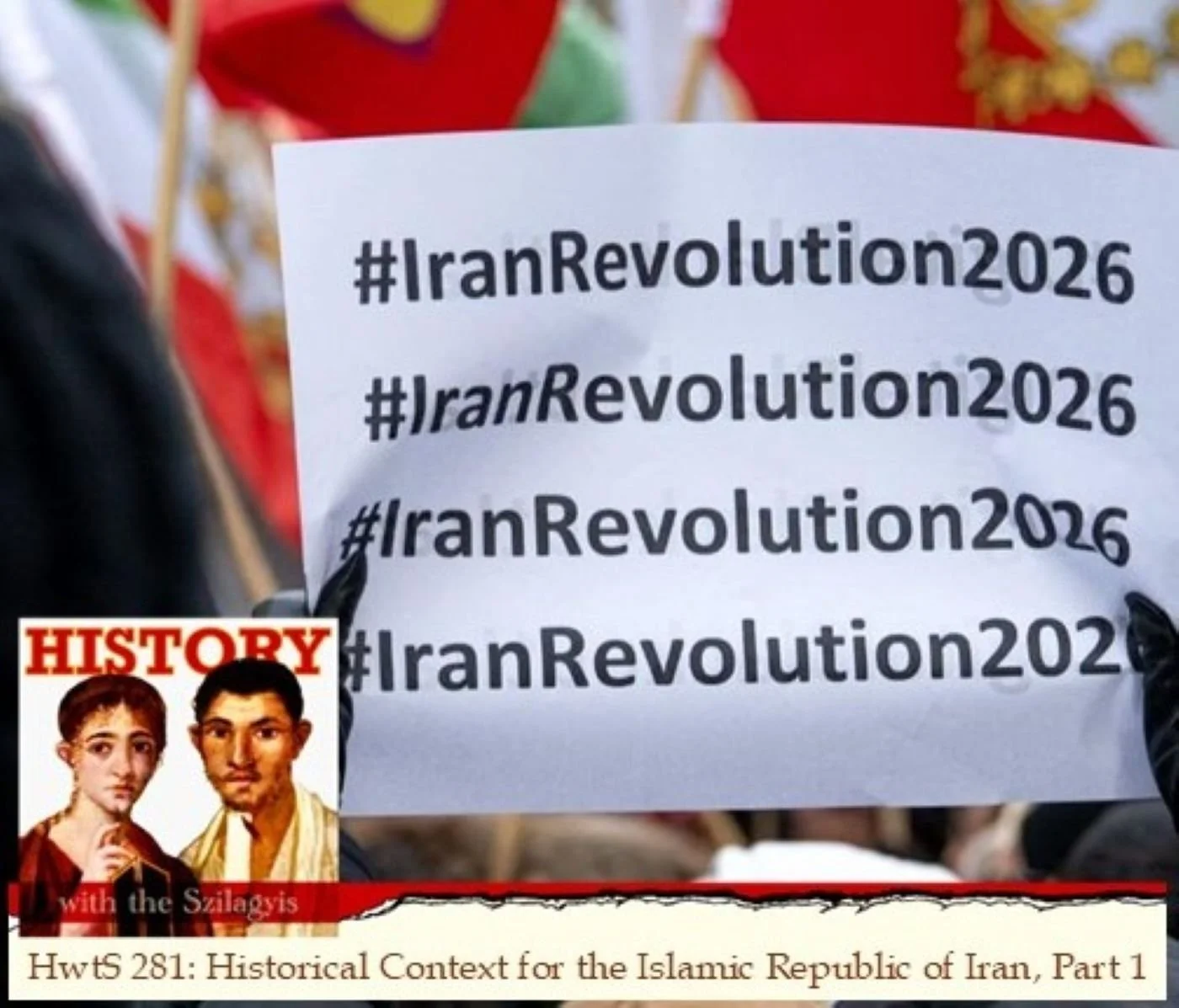
Context for the Islamic Republic of Iran, Part 1
—Jason
Listen here: https://www.spreaker.com/episode/hwts-281-context-for-the-islamic-republic-of-iran-part-1--69554232
The end of 2025 and beginning of 2026 has been a time of rising tension, fear, and in some cases, hope for various communities around the world. The Middle East is an area which throughout the twentieth and twenty-first centuries has suffered instability and violence. Conflict seems to be an endemic catastrophe that strikes this region time and time again in an endless rhythm.
Since its founding in the wake of the 1979 Iranian Revolution, the Islamic Republic of Iran has been isolated from much of the international community and considered a pariah state. The aftershock of the Iranian Revolution, overthrow of Shah Mohammad Reza Pahlavi, and creation of its subsequent theocratic government have spawned a series of crises which includes international sanctions, military actions by the United States, and its allies, and political and economic isolation.
The Islamic Republic’s grip on power has never been unanimously supported by the Iranian population. Internal protests, underground movements, and exiled members of this community have continuously struggled to create a more democratic, representative government and society. But how exactly did the Islamic Republic even start?
There are many reasons why the 1979 Revolution took place, and while these won’t be covered in this episode, I will provide some historical context for the event. Here are just a few basic reasons for the fall of the Shah and creation of the Islamic Republic of Iran: internal discontent with autocratic rule of the Shah, tensions due to external interference throughout much of the twentieth century, and the growing influence of Ayatollah Ruhollah Khomeini throughout the 1960s and 1970s.
Prior to the outbreak of the First World War, the Kingdom of Persia (as modern-day Iran was then known) had been a declining power that was drawn into both the British and Russian spheres of influence. Persia had long been an influential territory with roots going back thousands of years, yet the growth of economic and military strength in Western Europe during the nineteenth century outstripped the ancient kingdom. Its inability to modernize its economy and military left Persia vulnerable to the European imperial powers that were expanding in their direction.
The Great Game (roughly 1830-1907) in which Great Britain and Russia competed to dominate Central Asia had placed many of the small kingdoms and territorial entities in the crosshairs of the Great Power politics. Imperial Russia had been expanding its territories since the 1700s throughout the Caucasus region, Central Asia, and Siberia. Russian armies won key battles against the Qajar Persians and their neighbors, the Ottoman Empire. Russia expansion further weakened an already declining Muslim power.
Great Britain was opposed to Russian expansion in Central Asia and the Middle East because it was viewed as direct threat to British rule in India. The Indian Mutiny (1857-1859) was a bitter rebellion against the British East India Company’s mismanagement and cruelty towards the Indian population. Disaster was eventually averted when large numbers of British forces streamed into the subcontinent and brutally put the Mutiny down. London disbanded the East India Company in 1859 and took direct control of the most profitable colony in the British Empire.
The Great Game continued as the British increasingly feared Russian intentions in Afghanistan. Two wars were fought between Afghanistan and Great Britain resulting in humiliating withdrawals for the latter. The border region between Afghanistan and modern-day Pakistan (then part of the British India) is still hotly contested today. British control of India was secured, but neighboring Persia was in tough shape.
Russian forces during this same period had pushed both the Ottomans and Persians from much of their previous holdings in the Caucasus region. This strip of land between the Black and Caspian Seas connects Ukraine and southern Russia with the Middle East. The region was, and still is, a strategically vital route for any empire or kingdom wishing to secure its borders, expand trade, and have communication with neighbors. In the nineteenth century, Russian control of the Caucasus region potentially opened the door for their expansion into the Middle East threatening India from another direction.
Great Britain offered to provide loans to the Qajar Dynasty to help repel further Russian aggression. These loans were meant to help modernize the Persian army with European weapons and training: of course, it would be British weapons manufacturers and officers who would spearhead this effort. The Qajars couldn’t easily repay these loans and so Britain slowly consolidated power within the southern region of Persia along the Indian Ocean and Persian Gulf.
By the end of the nineteenth century, the Qajars had little, if any, real political power in their own territory. Britain occupied the south and Russia continued to push into the northern part of Persia. The only appearance of power the Qajars practiced was controlling Tehran, their capital city, with British and Russian approval.
European imperialism, militarism, and nationalism all grew throughout the last decades of the 1800s. The Unification of Germany in 1871 upset the balance of power within Europe. A new state that was heavily industrialized, and militarized, was stretching its muscles to take its place in the world. While it had the largest and best equipped army in Europe, Imperial Germany sought to gain overseas colonies and began to construct the second largest navy in the world. These events led Germany on a collision course with Great Britain.
Arms races further reinforced tensions between the Great Powers of Europe. The new German navy was building battleships and smaller warships to complete against the British Royal Navy. Every year the two countries introduced new and improved designs. Great Britain eventually adopted a policy of doubling the number of new battleships built each year for every German one completed.
The naval arms race was in full swing by 1900: bigger guns and armor led to larger ships being constructed. The commissioning of the HMS Dreadnought by the British in 1905 once again upset the balance of international relations. Dreadnought was the first of a new type of battleship that was heavily gunned, heavily armored, and fast compared to all previous ships. It gave Britian the edge at its christening but wiped out the Royal Navy’s numerical superiority because every other naval power began building this type.
Coal was the main fossil fuel used to power the warships of the world’s navies. But it was bulky and heavy, difficult to load, and had a short range. By 1908, the British Royal Navy was interested in switching the fuel used in new classes of dreadnoughts: they looked towards oil-fired engines. Great Britain during this period did not have a native source of petroleum (offshore oil rigs were still decades into the future) and began looking for a source they could exploit.
Southern Persia happened to be one of the largest untapped reservoirs for petroleum and fell within the British sphere of influence. On 26 May 1908, George Reynolds discovered a massive petroleum reserve at Masjed Soleyman (modern-day Maidan-e Naftun). Reynolds worked for William Knox D'Arcy, a millionaire London socialite, who in 1901 had negotiated an oil concession with Mozaffar al-Din Shah Qajar of Persia. After seven years of searching for a commercially viable site, the British had found the future source of fuel.
The Anglo-Persian Oil Company, or APOC, (now known as British Petroleum or BP) was founded in 1909 and by 1914 the British government owned 51% of the shares. This gave the British government not only control of the company, but it also effectively gave them the ability to determine where the profits of the petroleum were directed: an overly large amount went to Great Britain and the rest as split with the Shah. In theory, the Shah was supposed to use the profits to bolster the economy, modernize the military, and provide funding for the population; however, this rarely happened.
Large volume production of Persian oil products began in 1913 from a refinery built at Abadan, which was for its first 50 years, the largest oil refinery in the world. Over the next three years, every ship in the Royal Navy, including newest classes of British dreadnoughts, were built specifically to burn oil. Great Britain had narrowly secured its new fuel supply on the eve of the First World War.