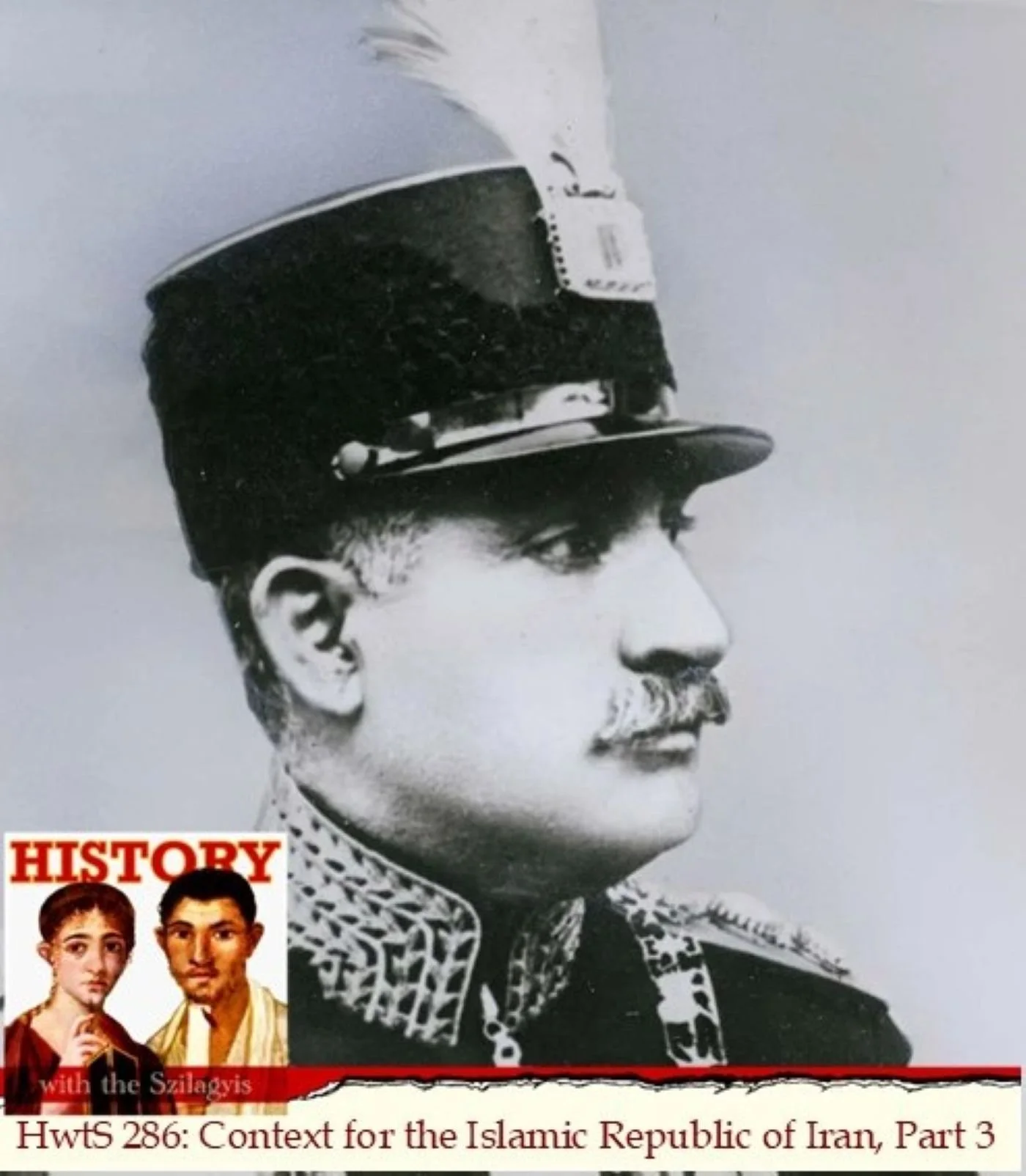
Context for the Islamic Republic of Iran, Part 3
—Jason
Listen here: https://www.spreaker.com/episode/hwts286-context-for-the-islamic-republic-of-iran-part-3--72860022
This is part three of a continuing series discussing the context of Iran beginning with a history of the country in the twentieth and twenty-first centuries. Please read part one for more background information pertaining to the region before the outbreak of World War I and part two for the events of World War I.
The aftermath of the Great War (1914-1918) left the world in a state of crisis as old powers collapsed, and new states emerged from the sundered territories. The dissolution of the German Empire, Austro-Hungarian Empire, and Russian Empire in Europe allowed for the birth of a numerous of nation-states in Central and Eastern Europe. The collapse of the Ottoman Empire also led to the creation of most modern Middle Eastern states.
The Qajar Kingdom of Persia, while technically neutral during the Great War, was also fatally weakened. As explained in previous episodes, the Qajar Dynasty barely held independent political power within their own territory thanks to British and Russian interference. South and central Persia were under the British sphere of influence while northern Persia fell to the Russians. The Qajar shahs had been reduced to the level of puppet kings even before the Great War started.
While Great Britan emerged as one of the winning participants in 1918, its empire and resources had been stretched to the breaking point. Having to maintain such a huge number of military personnel, equipment, acquisition of food and supplies, as well as maintaining an ever-expanding infrastructure had decimated the treasury.
On top of its pre-war commitments, Great Britain also absorbed a huge swathe of former Ottoman territory as part of the peace settlement. The Sykes-Picot Agreement had been negotiated between Great Britain, France, and Russia between 23 November 1915 and 3 January 1916. The treaty effectively divided the Ottoman Empire into post-war spheres of influence between the three Entente powers. The creation of the Russian sphere of influence was abandoned following the outbreak of the Bolshevik Revolution in November 1917 and the subsequent Russian Civil War.
Great Britain was given the authority as Mandate Power over the territories of Transjordan/Palestine and Iraq. Transjordan/Palestine was to be split between a Jewish homeland (modern Israel and the Occupied Territories) an Arab kingdom (the Hashemite Kingdom of Jordan). Ostensibly the main reasoning behind this Mandate was for Transjordan to act as a shield for British control of the Suez Canal.
However, the decision to create a Jewish homeland within Palestine created a permanent rift between the British and their Arab allies. At the outbreak of the Great War, the Hashemites had been in control of the Hejaz, the western coastal region of the Arabian Peninsula where Mecca and Medina are located. They were the guardians of two of the three most holy cities for Muslims and were Ottoman vassals: however, they had long wished to be independent of the Turks.
Between 1915 and 1916, Hussein bin Ali, Sharif of Mecca, and Lieutenant Colonel Sir Henry McMahon, British High Commissioner to Egypt, had exchanged letters regarding the potential for an Arab revolt against the Ottoman Empire. The McMahon-Hussein Correspondence laid out the general outline of how Hussein’s followers would throw off Ottoman control of their homeland and create a new Arab state within both the Arabian Peninsula and Middle East. Both sides had a very different understanding of how these “promises” were to be handled once the war was over.
McMahon's promises were seen by the Arabs as a formal agreement between themselves and the United Kingdom. British Prime Minister David Lloyd George and Foreign Secretary Arthur Balfour represented the agreement as a treaty during the post-war deliberations of the Council of Four. On this understanding the Arabs, under the command of Hussein's son Faisal, established a military force that fought, with inspiration from T. E. Lawrence ("Lawrence of Arabia"), against the Ottoman Empire during the Arab Revolt (1916-1918).
The Arab Revolt has been the topic of much debate over its overall significance to the Great War: for some its seen as merely a sideshow with little gain, and for others it’s the essential budding start of Arab nationalism. While Faisal and Lawrence led their fighters within the northern Arabian Peninsula and Transjordan, a concurrent campaign conducted by the British and Egyptians was striking through the Sinia Peninsula into southern Palestine finally capturing Jerusalem by December 1917. Critics of the Hashemites contend that their forces contributed little to the destruction of the Ottoman Empire. Yet, the reality of having so many different enemies striking from various directions did prevent Turkish forces from being able to concentrate on a single foe.
Fractures within the British-Hashemite alliance had already begun to appear by 1917 and only continued to widen. The Germans leaked the contents of the Balfour Declaration to the world in November 1917. The Balfour Declaration was an exchange of telegrams between Arthur Balfour, the British foreign secretary, to Lord Rothschild, a leader of the British Jewish community, for transmission to the Zionist Federation of Great Britain and Ireland stating that the British Government was amenable to the creation of a Jewish homeland in Palestine.
This declaration was in direct opposition to the Arab interpretation of the McMahon-Hussein Correspondence. According to the Hashemite and Arab interpretation, the former Ottoman territory would be split into independent Hashemite kingdoms: Syria, Palestine, and Transjordan being given to Hussein’s sons to rule. The Balfour Declaration shook Hashemite confidence in the British.
Again, you are probably asking why are you telling me about Jordan, Israel, Syria, and Iraq if this episode is about Iran? And I will say once again, the historical context for any territory in the modern Middle East didn’t happen in a vacuum.
The proposed division of the former Ottoman Empire between Great Britain and France did not go as easily as the European powers wanted. At the Treaty of Versailles, Faisal and Lawrence arrived to represent the Hashemites and they were promptly ignored.
The Sykes-Picot Agreement went into effect: Great Britain received Transjordan/Palestine and Mesopotamia and France received Syria.
Syria was supposed to be the seat of Faisal’s kingdom and Transjordan/Palestine was to be given to Abduallah (another of Hussein’s sons). The British offered Abduallah Transjordan with their understanding that it would be split between the Jewish and Arab populations (although no real plan had been laid out on how this would work).
Faisal was stuck without support from his British allies when it came to taking control of Syria. The French had no interest in him being the king of the region. A brief revolt against French control of Syria ended with Faisal and his followers being chased out of Syria by the French garrison. Humiliated, and infuriated, Faisal was forced into exile inside Transjordan.
At the same time this was happening, the British were facing a bitter, largescale revolt in Mesopotamia. The population of this territory was split along both religious and ethnic lines: Shi’ite Muslims dominated the central and southern portions of Mesopotamia, while Sunni Muslims the remaining central region, and the Kurds were the dominant group in the northern territories. Not surprisingly, these groups wanted their own autonomous states and were fully against British rule.
Moreover, the Turks had not accepted the terms of 1920 Treaty of Sèvres. This had stripped huge chunks of territory away from the former Ottoman Empire and left only a small Turkish state. The Kingdom of Greece forcefully landed troops along the western coast of Turkey to seize their promised territorial concessions. The terms of the treaty and subsequent Greek actions stirred hostility and Turkish nationalism. The treaty's signatories were stripped of their citizenship by the Grand National Assembly, led by Mustafa Kemal Pasha, which ignited the Turkish War of Independence (15 May 1919 – 24 July 1923). This brutal war took place in the immediate aftermath of the War to End All Wars.
Turkish forces counterattacked the Greeks in the interior of Turkey and pushed them back to the Mediterranean coast. The Turkish Assembly and Bolshevik Russia also agreed to split the newly created Armenian state between them. France had no real interest in helping either the Greeks or Armenians and the British were increasingly frustrated with the tensions brewing within their Middle Eastern territories. Eventually, the “Turkish issue” was solved by the Treaty of Lausanne on 24 July 1923 whereby the Turkish Republic was officially recognized by the British, French, and Greeks.
All this turmoil within the former Ottoman Empire was wearing thin on an already overstretched British government. Calls for demobilization of most British armed forces were driven by the need to cut costs as much as the end of hostilities. Garrisoning the existing Empire was hard enough in peacetime and now a huge chunk of the Middle East was part of the British Mandate and threatening to explode.
The British Colonial Office, in charge of the colonies, was desperate to find a solution for the troubles in the Middle East. Winston Churhcill, the newly appointed Colonial Secretary, called together a collection of British officials and military leaders to discuss how the chaos could be calmed: the Cairo Conference was to be the forum to mend all the damages.
The meeting was held at the Semiramis Hotel in Cairo starting on 12 March 1921. The agenda consisted of three sections: Iraq, Palestine (including Transjordan), Aden and the Persian Gulf. The Judiciary, Finance, the size of the British Army garrison and the proposed Legislative Council were all on the agenda. An Arab delegation from Palestine met Churchill in Cairo briefly on 22 March, at which he refused to discuss anything political but agreed to meet them in Jerusalem (where he offered virtually no reassurances their concerns would be considered).
The issue of Transjordan was complicated by the arrival of Abdullah's army in Amman, the soon to be capital city, and with an influx of rebels and refugees from Faisal’s failed Syrian revolt and the fact that the Zionists regarded Transjordan as part of the promised Jewish Homeland.
Churchill held a series of meetings with Abdullah in Jerusalem on his way back to London where it was agreed that lands west of the Jordan River would fall within a separate Hashemite Arab state.
The creation of the Hashemite Kingdom of Transjordan and the concurrent Palestine Mandate was not universally accepted. Both Arabs and Zionists each opposed the division of the territory. Arabs believed that the entire territory should be under Hashemite control according to the McMahon-Hussein Correspondence. Zionists felt that this entire area had historically been the Jewish homeland and that the British were obligated to give to them.
One example of violence between the Arab and Jewish communities in Palestine was the 1920 Nebi Musa, or Jerusalem, riots, which took place in the British-controlled part of Occupied Enemy Territory Administration from 4 to 7 April 1920 in and around the Old City of Jerusalem. Five Jews were killed and several hundred injured; four Arabs were killed and 18 injured; seven Britons were injured. The British military administration of Palestine was criticized for withdrawing troops from inside Jerusalem and because it was slow to regain control. As a result of the riots, trust among the British, Jews, and Arabs eroded.
Amin al-Husayni, the Grand Mufti of Jerusalem, was a fierce critic of the partition of Palestine and was arrested in the aftermath of Nebi Musa Riots. He was quickly released by the British and he fled first to Syria and to Germany. Al-Husayni quickly became the face of Palestinian resistance to both British rule in Palestine and the creation of a Jewish homeland.
The Nebi Musa Riots were not the end to the troubles in Palestine and Transjordan, rather they early warning sign that this region would be plagued by sectarian violence that still reigns today.
The question of what to do with Faisal was also answered by the Cairo Conference: send him to rule Mesopotamia. The British belief was that since Faisal was an Arab Muslim, he would face no opposition to his rule over Mesopotamia. Sadly, this was not to be the case: Faisal was thrown into a completely new state with a hostile population.
Since the outbreak of the revolt, the British Royal Air Force had been being used to suppress it. The city of Basra, located in southern Iraq, was the primary location for the RAF bomber forces hitting villages and towns along the Tigris and Euphrates Rivers. Indiscriminate bombing of civilian targets with both conventional and chemical weapons added further anger to the rebel cause.
On 23 August 1923, Faisal was crowned as King of the Hashemite Kingdom of Iraq. Renaming Mesopotamia to Iraq was viewed by the British to legitimize his ascension. The British press crowed that a 96% positive public referendum by the Iraqi people solidified Faisal I’s transition from expelled ruler of Syria to King of Iraq.
Finally, we can turn to what was happening in Persia during this same period. The lack of economic, military, and political willpower available to the British led them on a different path when dealing with the Qajars. Great Britain had hoped that the Qajar Shah would remain a pliable asset to London, yet he was pushing for his independence and that could not be forgiven.
By 1920, both the British and some elements of the Persian military had grown to distrust the Qajar dynasty. British General William Ironside was tasked by War Office to help organize the North Persia Force on 26 September. Ostensibly this force was designed to combat Bolshevik-supported forces that were operating within Persian territory and potentially threatening to march on Tehran.
And at the same time, he was given the authority to build a relationship with the Persian Cossack Brigade. In December 1920, Ironside appointed the future shah, Colonel Reza Khan, as commander of the Persian Cossack Brigade, and subsequently groomed him for the role of Persia's strongman against the Bolshevik influence, leaving instructions for Reza to be gradually released from British control: this left the door open for Reza Khan to seize power.
Since 1915, the Jangal, or Jungle, Movement had grown in the Persian province of Gilan along the southwestern coast of the Caspian Sea. This region fell in the Russian sphere of influence and was not surprisingly hostile to both the Qajars and the British. The Great War was the perfect setting for this group to build more support against outside interference in Persia. They could easily point to both the corruption and incompetence of the Qajar Shah as justification for their movement.
Mirza Kuchik Khan was the leader of the Jangal Movement and had support from the peasantry and constitutionalists. He sought to end government corruption and establish a constitutional Persian state. Mirza did work with other political movements to advance his agenda. Iranian Bolsheviks would form a working alliance with the Jangalis, even though their political ideologies greatly differed.
Before the 1917 Revolutions, the Russian forces in the region had kept the Jangal Movement from conducting a true independence movement. However, with the Bolshevik Revolution sparking the subsequent Russian Civil War, that occupation devolved into fighting amongst itself.
Britain became wary of Mirza and the Jangal Movement and in 1917 attempted to assassinate him. This failed and poisoned any future cooperation between the British and the Jangalis. This would have dire consequences for both the White Russians (those fighting against the Bolsheviks) and the Jangal Movement itself.
During the Russian Civil War, the United States, France, Great Britain, and Japan sent intervention forces into various regions of the former Russian Empire to stop the Bolsheviks. These attempts to sway the outcome all eventually failed, and they left lasting damage to everyone involved. The Jangalis repeatedly refused to allow British forces to go through mountain passes which they controlled while allowing the Bolsheviks to operate in those areas.
Reza Khan, and the Persian Cossack Brigade, were hostile to the Bolsheviks, the Jangal Movement, and the Qajars. Reza Khan was, however, in no position to overthrow the shah himself. He was a relatively low-ranking military commander in a backwater part of Persia and had few, if any, real politically powerful friends.
Reza Khan would be an ally to the person who led the 1921 Persian Coup d'état: Seyyed Zia al-Din Tabataba'i Yazdi. Zia was a journalist and pro-Constitution politician who wanted to reform the Qajar dynasty, not necessarily replace it. He wanted to get rid of the pro-British ministers in government, end the autocratic rule of the Qajars and have a constitutional monarchy, and land reform to help the peasants. He also called for a closer relationship with the new Soviet Union. Zia did not realize that by doing these things, he would enable Reza Khan to name himself as new ruler of the kingdom.
Zia came to power in the coup d'état of 22 February 1921 when he gave an impassioned speech to the Persian parliament denouncing how the kingdom had been led by the corrupt political class. Within days, Ahmad Shah Qajar appointed the thirty-three-year-old firebrand as the Prime Minister of Persia.
A new government declared that his cabinet's program included far-reaching measures such as the "formation of an army...eventual abolition of the capitulations...establishment of friendly ties with the Soviet Union."
Zia also talked of land reform, making him one of the early champions of the idea in modern Iran. He talked of making education available to every Iranian. His political reform program envisaged that the entire legal system of Iran should be modernized and aligned with European standards. Overall, this potentially was a sweeping reset of Persian society. Yet, it was never meant to be.
The necessary funds were simply not available to stimulate the economy or to invest in infrastructure. The abolition of the rights of surrender for the British and Russians also made no headway. And Zia struck fiercely at those he saw as enemies: squads arrested personal and political enemies, and these included private citizens and nobles.
Zia’s actions and attitude ensured that his list of enemies continued to grow, and they even included Ahmad Shah Qajar, who no longer wanted to support the radical reform program. But above all the Shah wanted the release of the arrested nobles. Zia's last meeting with Ahmad Shah took place only hours before his dismissal and days before his exile.
Ahmad Shah turned to Reza Khan to help force Zia out of both the office of prime minister and Persia itself. On 23 May 1921, Reza Khan asked Zia to resign and leave the country. He offered any sum he deemed necessary from the treasury. Zia took twenty-five thousand toman to cover his travel expenses—by no measure a large sum—and left the country. All political prisoners were released on 24 May 1921.
Why was Reza Khan able to convince his political partner to go into exile? He was the true power behind Zia’s government.
He had been instrumental in helping Zia assume power by his control of Persian Cossack Brigade. Reza Khan was made Minister of War after Zia was made Prime Minister. He had the best equipped and trained military units in Persia under his personal command. After being named Minister of War, Reza Khan quickly assumed the dominant military position and purged anyone in Tehran who opposed him. Ahmad Shah appointed him to Commander-in-Chief of Persian Army as a reward for his support against Zia.
By 1923, Reza Khan had largely succeeded in securing Iran's interior from any remaining domestic and foreign threats. Upon his return to the capital, he was appointed prime minister, which prompted Ahmad Shah to leave Iran for Europe, where he would remain (at first voluntarily, and later in exile) until his death.
This voluntary exile by the Qajar shah induced the Parliament to grant Reza Khan dictatorial powers, who in turn assumed the symbolic and honorific styles of Janab-i-Ashraf (His Serene Highness) and Hazrat-i-Ashraf on 28 October 1923. He quickly established a political cabinet in Tehran to help organize his plans for modernization and reform.
By October 1925, Reza Khan succeeded in pressuring parliament to depose and formally exile Ahmad Shah and instate him as the next Shah of Iran. Initially, he had planned to declare the country a republic, as his contemporary Atatürk had done in Turkey, but abandoned the idea in the face of British and clerical opposition.
Reza Khan was declared the Shah (King) of Iran on 12 December 1925. Three days later, on 15 December, he took his imperial oath and thus became the first shah of the Pahlavi dynasty. Reza Shah's coronation took place much later, on 25 April 1926. It was at that time that his son, Mohammad Reza Pahlavi, was proclaimed crown prince.