Context for the Islamic Republic of Iran, Part 4
—Jason
Listen here: https://www.spreaker.com/episode/hwts-287-context-for-the-islamic-republic-of-iran-part-4--72900656
This is part four of a continuing series discussing the context of Iran beginning with a history of the country in the twentieth and twenty-first centuries. Please listen to part one for more background information pertaining to the region before the outbreak of World War I, part two for the events of World War I, and part three for the events leading to the ascent of the Pahlavi Dynasty.
The official 1926 coronation of the Pahlavi Dynasty in Tehran established a new ruling power within the Middle East. Reza Shah began the process of shifting his country towards reform.
His vision of how to push his subjects towards a modern and secularized territory was modelled after another young Middle Eastern country: the Republic of Turkey. The shadow of the Great War was still shrouding the destiny of the region.
Following the dismemberment of the Ottoman Empire after World War I, Turkish leader Mustafa Kemal Atatürk became the symbol of secular rule within the region. Kemal led the Turks during the Turkish war of Independence (15 May 1919 – 11 October 1922). According to the Treaty of Sevres (10 August 1920), the Entente Powers subdivided the region of Turkey into several regions of occupation for the Greeks, the Italian, Armenians, and oh so briefly, the Kurds.
Although the Italians did not move into to occupy the region they had been awarded, the Kingdom of Greece did send in military forces to seize the Ionian coast. This territory had been a matter of contention for centuries. What followed this occupation was a war between Greece and Turkish nationalists which raged for over three years. Eventually the Turks were able to push the Greeks out their region and establish the Republic of Turkey. The Treaty of Lausanne (24 July 1923) was signed, and this finalized the borders of the new state. Kemal was elected president of Turkey and led the country as a secular republic.
Reza Shah witnessed this triumph and sought to emulate the secularization of Persia along similar lines. He wanted to create a kingdom where power was concentrated in the hands of the monarchy and break the power of the imams, Shi’ite religious leaders, who had low acted a check to previous rulers. Reza Shah, however, could not immediately begin this program of stripping the religious leaders of their authority. So, he sought to modernize and reform other elements of Persian society as well as shift the perceived weakness of the state within the international community.
In 1935, Reza Shah, moved towards formalizing the name Iran instead of Persia for all purposes both inside and outside the country. This was a bit of propaganda designed to distance his new regime from the previously failed ones.
Reza Shah was doing some historical revision: the Iranian peoples inside their country since the time of Zoroaster, the famous mystic who founded the religion Zoroastrianism, (circa 1000 BCE), or even before, had called their country Arya, Iran, Iranshahr, Iranzamin (Land of Iran), Aryānām or its equivalents. Persia was the name given to them by the ancient Greeks.
While the country underwent this official name change, Reza Shah was also moving Iran into friendlier relations with German at the expense of Great Britian. In 1931, Reza Shah refused to allow Imperial Airways to fly in Persian airspace, instead giving the concession to German-owned Lufthansa Airlines.
The next year, 1932, he surprised the British by unilaterally canceling the oil concession awarded to the Anglo-Persian Oil Company, which was slated to expire in 1961. The concession granted Persia 16% of the net profits from APOC oil operations: the Shah wanted 21%. Eventually a new deal was negotiated.
Reza Shah also purchased ships from Fascist Italy and hired Italians to teach his troops the intricacies of naval warfare. On top of this, Reza Shah also hired German technicians and advisors for various projects. He was careful to avoid giving any one foreign nation too much control of either the economy or military. He insisted that foreign advisors be employed by the Iranian government, so that they would not be answerable to foreign powers.
Also happening in the 1930s, the war clouds were gathering in Europe as Nazi Germany remilitarized and began absorbing territories that had been lost under the Treaty of Versailles. Adolf Hitler, the German Chancellor, had by 1938 reoccupied the Rhineland, annexed Austria, and pushed for the annexation of Sudetenland from Czechoslovakia.
Great Britian and France had been practicing the policy of appeasement to give themselves a chance to rearm before a general war broke out. However, they were running out of both time and space to contain Hitler’s appetites. German delegations had laid the groundwork for a potential alliance with Arab and Iranian states seeking to break away from British and French control.
On 1 September 1939, Germany launched its invasion of Poland and the Second World War erupted. The Shah immediately declared that Iran was a neutral power in the conflict. However, he did wish for the Nazis to break the British thereby forcing them to abandon their hold over the Angolo-Persian Oil Company. A German victory with Arab and Iranian allies might also redraw the map of the Middle East where Iran grew in power.
The entry of Fascist Italy and the Fall of France in June 1940 left Great Britain as the only nation opposed to German and Italian domination of Europe, North Africa, and the Middle East. While Reza Shah did officially practice neutrality, he enacted policies that to the British seemed very pro-Nazi. Fears of the Abadan Oil Fields falling into German hands pushed the British towards a confrontation with the Shah.
Germany’s attack on the Soviet Union in June 1941 altered the balance of the Second World War in many ways. What is most important to this podcast is how these affected British and Soviet attitudes towards the Middle East.
German armies had penetrated deep into the western part of the Soviet Union by December 1941 with elements of Army Group Center on the outskirts of Moscow. The British government had started to send military aid to the Soviet Union, but the oceanic routes were horrendously dangerous. Merchant ships had to leave Great Britian and sail through the Arctic Ocean around German-occupied Norway and Axis allied Finland to unload the supplies. This route led to significant Allied losses and a different route for Lend-Lease Aid needed to be utilized: hence British and Soviet (and later US) interest in a friendly Iran.
However, it was events in the neighboring Hashemite Kingdom of Iraq that sealed the Shah’s fate. The Anglo-Iraqi War was a British-led Allied military campaign against Rashid Ali al-Gaylani who had seized power in the 1941 Iraqi coup d'état with assistance from Germany and Italy. The government of the Kingdom of Iraq had been friendly towards Great Britain since the outbreak of the war. Gaylani led a military coup to overthrow the pro-British regime of Regent 'Abd al-Ilah and his Prime Minister Nuri al-Said.
This was direct threat to British interests throughout the region and the British military acted swiftly. Military units landed around the city of Basra and confronted rather disorganized and reluctant resistance from the first Iraqi units they encountered. While this was not a bloodless campaign, the British were able to overcome the military forces supporting Gaylani and restore Prime Minister Nuri al-Said.
Then the uncomfortable question of the continuing to rely on the word of the Shah’s neutrality needed to be answered. Prior to the invasion, two diplomatic notes were delivered to the Iranian government on 19 July and 17 August, requiring the Iranian government to expel German nationals. When this ultimatum was ignored, the Allies struck. The British Royal Navy and Royal Australian Navy attacked from the Persian Gulf, while other British Commonwealth forces came by land and air from Iraq. The Soviet Union invaded from the north, mostly from Transcaucasia. The Iranian military forces were caught unprepared: by 28–29 August, the Iranian military situation was in complete chaos. The Allies had complete control over the skies, and large sections of the country were in their hands.
Reza Shah did not immediately surrender; he ordered what was left of the Iranian army and the civilian population to not fight the invasion. Despite this, the Shah placed Mohammad Ali Foroughi, a former prime minister whom he had previously forced out of office, to resume the role of Prime Minister. And this was another element to Reza Shah’s downfall.
When he entered the negotiations with the British, instead of negotiating a favorable settlement, Foroughi implied that both he and the Iranian people wanted to be "liberated" from the Shah's rule.” The British and Soviet agreed when the Shah dragged out the negotiations allowing German nationals in Iran to escape to Turkey.
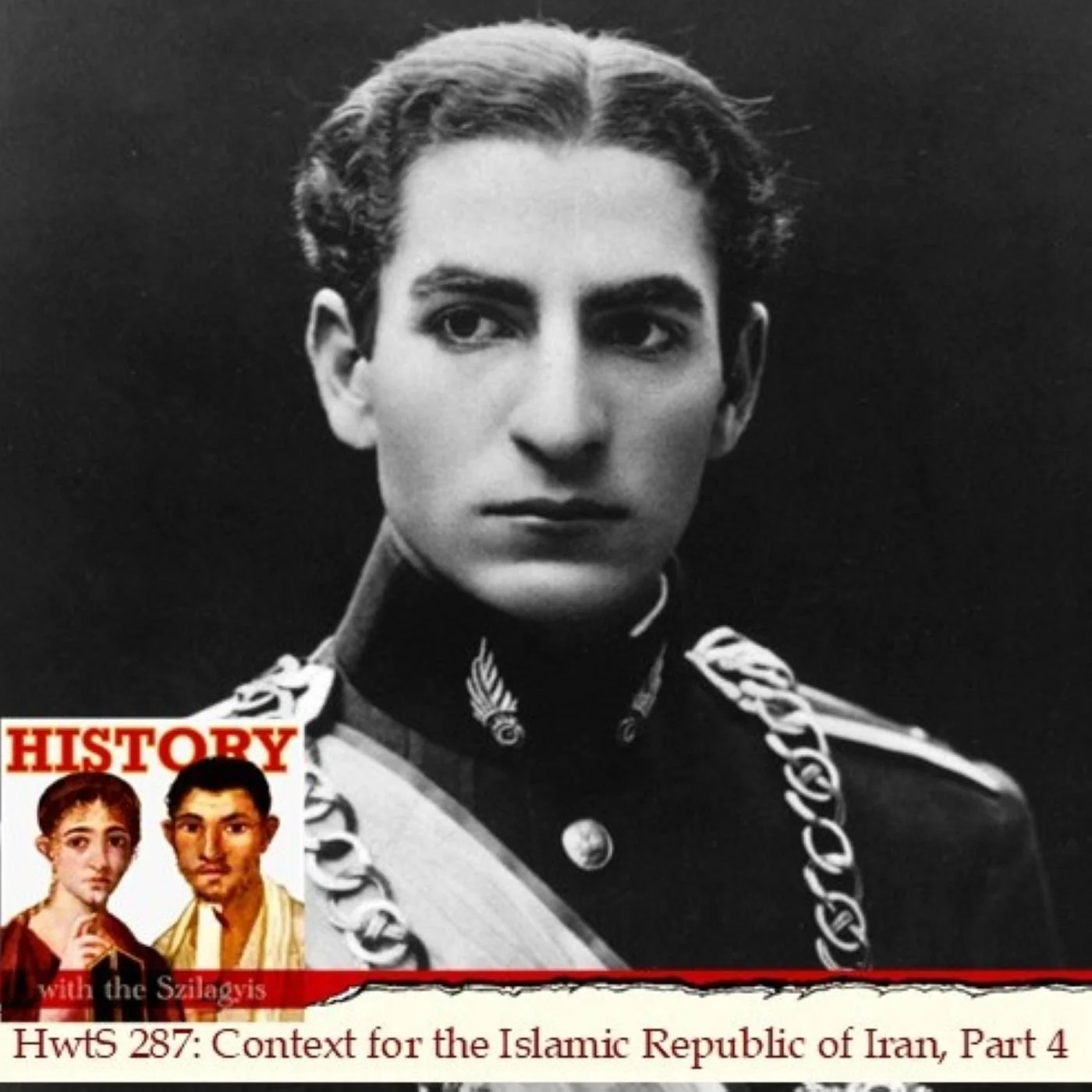
Reza Shah, in a letter handwritten by Foroughi, announced his abdication, as the Soviets entered the city on 17 September. The British wanted to restore the Qajar dynasty to power, but the heir Hamid Hassan Mirza, was a British subject who spoke no Persian. Seeing this as unacceptable Foroughi suggested that Crown Prince Mohammad Reza Pahlavi take the oath to become the new Shah of Iran.
At 22 years old, Mohammad Reza Pahlavi replaced his father as ruler of Iran. In full truth, he was not an independent ruler: his country would be under joint Allied occupation until their final withdrawal in 1946. This was to ensure that he would remain loyal to the Allies and that another route for military aid could reach the Soviet Union.
As for Reza Shah, once he abdicated, he was forced into exile. First, he lived on the island of Mauritius in the India Ocean. Then he was moved to Durban, Ireland for a period before finally settling in Johannesburg, South Africa. Reza Shah died on 26 July 1944 of a heart problem at the age of sixty-six.
Mohammad Reza Shah entered power with the shadow of his father’s forced abdication over his head. His own subsequent actions would eventually seal the fate of the Pahlavi Dynasty.